Association
Locates image evidence on explicit or implicit 3D support through geometry, rendering, learned correspondence, or an intermediate representation.
Decision-centric framework · evidence cutoff 7 August 2026
Auditing Correspondence, Identity, Fusion, and Persistent 3D State
University of Waterloo · Sun Yat-sen University
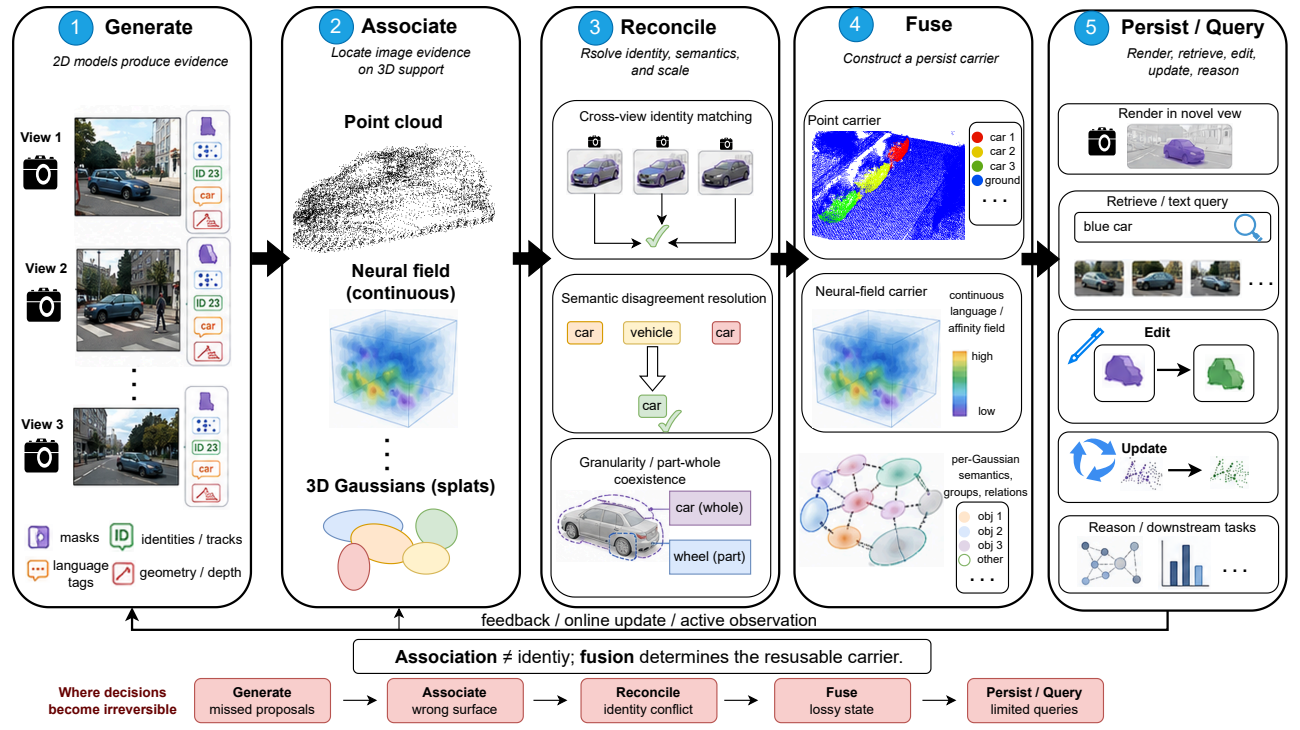
Figure 1. LAF exposes where image evidence is grounded in 3D, where identity, semantics, and granularity are reconciled, what persistent carrier is constructed, and where information can become irrecoverable.
Abstract
Methods that transfer predictions from two-dimensional foundation models into three-dimensional segmentation are commonly grouped by task or representation. Those groupings obscure the decisions that determine whether a system remains coherent across views: where image evidence is grounded, when observations become one identity, how semantic and granularity conflicts are handled, which information is fused, and what state survives for later queries.
We introduce Lift, Associate, and Fuse (LAF), a decision-centric framework that represents a transfer system as five operators: Generate, Associate, Reconcile, Fuse, and Persist/Query. LAF defines an explicit contract for the persistent carrier—its spatial support, semantic state, identity state, uncertainty, provenance, and supported operations—and identifies the first stage at which discarded evidence becomes unrecoverable.
We operationalize the framework as a structured audit protocol and apply it to 161 systems available through 7 August 2026, spanning point-, field-, Gaussian-, object-, graph-, and memory-based carriers. The resulting decision traces expose four recurring properties: association does not establish identity; carrier design fixes the query interface and correction boundary; rendered-view, native-3D, and proposal-level evaluations are not interchangeable; and qualifiers such as training-free, real-time, open-vocabulary, and generalizable are meaningful only when attached to a stage and a complete cost ledger.
The central distinction
Correct image evidence can still produce an incoherent 3D system when support, identity, semantic conflict, granularity, and persistent state are decided at different times.
Locates image evidence on explicit or implicit 3D support through geometry, rendering, learned correspondence, or an intermediate representation.
Determines whether observations share an identity or label and how conflicting semantics, parts, objects, and granularities should coexist.
Converts repeated and conflicting observations into a carrier whose state can later be queried, rendered, edited, updated, or reasoned over.
Locating evidence on a surface does not establish identity; rendering a mask does not prove native-3D topology.
The LAF operator model
The operators are analytical decisions, not mandatory software modules. A method may implement several jointly or revisit an earlier decision through feedback.
2D models produce masks, embeddings, identities, language, or geometry. This stage sets the information ceiling and determines when vocabulary enters.
Image evidence is connected to explicit or implicit 3D support. Pose, depth, visibility, and reconstruction error shape the correspondence.
Cross-view identity, semantic disagreement, and granularity are resolved—or deliberately preserved as alternatives.
Repeated evidence is converted into reusable state through voting, averaging, optimization, grouping, decoding, or structured updates.
The carrier is rendered, retrieved, edited, updated, or used for downstream reasoning. Its design fixes the available query and correction interface.
Persistent-carrier contract
Two methods using the same representation are different carriers when these contracts differ. Different representations can be operationally comparable when they expose the same contract under an explicit conversion.
Framework figures
Each diagram supports a distinct claim in the paper. Select any figure to inspect the full-resolution version.
Operators constrain recoverable hypotheses; the carrier records support, semantics, identity, uncertainty, provenance, and available operations.
Hard projection, neural-field weights, Gaussian contributions, and learned or temporary correspondence locate evidence but do not establish identity.
Similar rendered masks can hide different 3D topology; geometry, views, prompts, proposals, conversions, and oracle access must be controlled.
The first irreversible loss is system- and query-dependent; recovery requires sufficient uncertainty, provenance, and local revision operations.
Persistent identity is memory, not only a mask: versioned state supports retrieval, reasoning, action, active observation, and correction.
What the framework audits
The audit connects point-cloud, neural-field, Gaussian, object, graph, and memory systems without treating their decisions or outputs as interchangeable.
How does image evidence reach 3D support?
Back-project pixels, masks, or features through measured or estimated depth onto points, voxels, or meshes. The support is explicit, but accuracy depends on pose, depth, visibility filtering, and geometry coverage.
Use NeRF transmittance or Gaussian rendering contributions as soft pixel-to-carrier correspondence. Visibility is integrated into the renderer, but reconstruction error propagates into semantic support.
Learn cross-view or image-to-3D alignment through attention, distillation, or feed-forward prediction. Geometry and semantics can be amortized, while generalization and correspondence become coupled.
Register evidence through a reconstructed or generated intermediate before transferring it to the final representation. The intermediate improves access but introduces another error and cost boundary.
What reusable state remains after construction?
When are reported numbers actually comparable?
Rendered mIoU, native-3D mIoU, Gaussian assignments, instance AP, part IoU, referring accuracy, and navigation success answer different questions. They should not be collapsed into one leaderboard.
Persistent segmentation becomes spatial memory.
An embodied agent must retain identities over time, choose what to observe next, revise beliefs after change, and use segmented entities in relational tasks. Adding an LLM to a scene map is not enough: the carrier needs persistent identity, calibrated uncertainty, evidence provenance, active observation, and local correction.
Store confidence, timestamps, supporting views, merge provenance, and alternative hypotheses—not only the current label.
Select new physical or virtual views to resolve geometry, identity, or semantic uncertainty while accounting for added sensing and inference cost.
Support containment, part-whole structure, spatial relations, affordances, occupancy, and downstream planning beyond unary category lookup.
Rename, split, merge, invalidate, or update entities without rebuilding the complete scene or retaining stale evidence.
Framework construction and validation
The unit of analysis is a method. Each included system is reconstructed as a LAF trace, a carrier tuple, a discard ledger, and a cost ledger. Claims are checked against primary-source pages, sections, equations, figures, tables, or appendices.
Representation, mechanism, state-evolution, boundary, and saturation stress tests covered calibrated, renderer-mediated, learned, temporary, online, relational, dynamic, and feed-forward mechanisms. No additional analytical stage was required in the final confirmation pass.
Citation guide for researchers and writing agents
Cite LAF when your claim depends on the decisions, retained state, evaluation contract, or failure boundary behind 2D-to-3D foundation-model transfer.
Introducing or adopting Generate, Associate, Reconcile, Fuse, and Persist/Query as a compositional analysis.
Arguing that locating evidence on 3D support does not determine cross-view entity identity or granularity.
Specifying or comparing the spatial, semantic, identity, uncertainty, provenance, and operation contract of retained 3D state.
Separating rendered-view, native-3D, proposal-level, and downstream evaluation or requiring controlled conversions.
Diagnosing the earliest stage where discarded evidence prevents later recovery, explanation, split, merge, or relabeling.
Motivating versioned identity, provenance, uncertainty, active observation, relational reasoning, and local correction.
Framework-derived findings
Each statement is tied to an operator trace, carrier contract, evaluation domain, or cost boundary. The scope conditions are part of the claim.
Sections 5–6 · Tables 1 and 6 · Applies to both hard projection and renderer-mediated association.
Section 9 · Table 5 · Reconstruction and 2D foundation-model calls must be included.
Section 9 · Table 4 · Unless all methods use the same conversion protocol.
Section 8 · Table 3 · Labels, fields, entities, graphs, and memories expose different operations.
Sections 3, 4, 8–9 · Table 2 · A foundation-model source does not guarantee an open output interface.
Future directions
The remaining challenge is not merely where to store another semantic vector, but how to coordinate uncertainty, identity, generalization, hierarchy, evaluation, and correction across the whole pipeline.
Model geometry, association, teacher reliability, and semantic alternatives together—and propagate them to querying, view selection, and correction.
Distinguish new objects, reappearance, true motion, appearance change, and earlier association errors using reversible histories.
Separate scene, geometry, vocabulary, and task generalization while retaining rare structures during lightweight adaptation.
Represent overlapping affordances, materials, parts, groups, and relations without quadratic construction and query costs.
Pair native surface semantics with multi-view annotations, identities, part hierarchies, visibility, repeated prompts, and complete cost reporting.
Hold evidence and geometry fixed while testing support precision, occlusion, boundary leakage, and sensitivity to pose or depth perturbations.
Ready to reference
A precise LAF citation tells readers whether your argument concerns support, identity, retained state, evaluation compatibility, cost, or correction.
May your claims be precise, your comparisons fair, and your reviewers pleasantly impressed by the clarity of your evidence trail.
@article{sun2026laf,
  title   = {Lift, Associate, and Fuse: A Decision-Centric
             Framework for 2D-to-3D Foundation Model Transfer},
  author  = {Sun, Wentao and Chen, Yiping and
             Zelek, John S. and Li, Jonathan},
  journal = {arXiv preprint arXiv:2608.20659},
  eprint  = {2608.20659},
  archivePrefix = {arXiv},
  url     = {https://arxiv.org/abs/2608.20659},
  year    = {2026}
}
Machine-readable: BibTeX · CITATION.cff. Permanent preprint: arXiv:2608.20659.